Showing posts with label Hampstead Theatre. Show all posts

Monday, 17 September 2012

The Judas Kiss 15 September 2012

Who's in it? Rupert Everett, Freddie Fox, Tom Colley, Cal Macaninch, Ben Hardy,
Alister Cameron, Kirsty Oswald
Where did you see it? Hampstead Theatre

It has been a while, hasn't it. I struggled to see performances (where were all the Edinburgh previews this year?) and then write about them.

I return to blogging after seeing The Judas Kiss by David Hare. This production has the perfect recipe of a subject that still interests, over a century after his death, and a cast lead by theatre veteran Rupert Everett and the up and coming Freddie Fox. The story is divided into two halves; Oscar Wilde (Everett) on the evening before his arrest and Wilde after his release living with his lover and the cause of his downfall Lord Alfred 'Bosie' Douglas (Fox).In the middle you have Robbie Ross (played brilliantly by Macaninch), a man far more in love with Wilde than Wilde ever was with him, though clearly fond of him as he was Wilde's first male lover. Ross has the uneviable task of paying off the help (Oswald, Hardy and Cameron) whilst trying to get his friend away from the police. He is also go-between for Wilde and his wife Constance,  though we never meet  her, her  humiliation and hatred of Bosie comes through Ross. 


Everett shines as Wilde, but it is not a difficult part. The audience can empathise with Wilde's love for  his children who are estranged from him and his determination not to flee whilst he has the chance. What everyone struggles with is how he can love Bosie so, a man who introduced him to the rent boys who provide evidence against Wilde at trial, a man so spoilt and selfish yet so unaware.Hare (and Fox) could easily make Bosie a one dimensional villain but there is something intriguing and attractive about this horrible character that attracts Wilde (and Gallieo, played by the rather well-endowed Tom Colley). My only issue would be the second half, which drags but has the most potential (it is mostly a two hander between Wilde and Ross or Wilde and Bosie).
Fox, Everett and Macaninch in The Judas Kiss


I should warn, or mention in passing so you buy tickets, that there is a LOT of full frontal nudity in this play. Tom Colley is the highlight (Let's just say Fox is very keen to put on his bedsheet when wondering around the stage whereas Colley isn't) but it is all done tastefully, though maybe too darkly lit for some people's tastes.

I think what stuck with me was Wilde's comment that Judas's betrayal to Jesus wasn't dramatic enough. He hardly knew Jesus, it should have been John that administered the kiss. The saddest thing about Wilde is that he betrayed by EVERYBODY for something that wouldn't raise an eyebrow had he done these thigs a hundred years later.

Saturday, 9 June 2012

Chariots of Fire, 19 May 2012

Who's in it? James McArdle, Mark Edel-Hunt, Tam Williams, Simon Williams, Sam Archer, Savannah Stevenson, Natasha Broomfield and Jack Lowden.
Where did you see it? Hampstead Theatre (Transfers to the Gielgud Theatre on the 22nd June 2012)

I'm not sure if people have fond memories of the film Chariots of Fire. I think the fondness for it and its success is completely dependent on Vangelis's music as opposed to the whole "two men win races" thing.
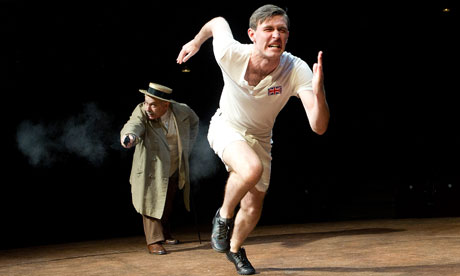
Director (and artistic director of Hampstead Theatre) Edward Hall desperately tries to recreate the beach scenes by having his company (elder member exempt) warming up (Really? they couldn't do this in their dressing rooms?) and running around the round stage in what could be a beautiful piece of choreography if they weren't wearing modern day t-shirts and tracksuit bottoms. I won't bore you too much with the plot, the plot is the same as the film version.

Chariots of Fire is more than two men win the athletics, it is about overcoming discrimination, your God or your love of sport etc etc but this stage play becomes about which actor can run around in circles most convincingly. It doesn't make the play exciting and any tension that has been created is then slowed down by watching people run around. The scenes set in Paris 1924 feel anti-climatic and lose meaning because you know all comes good. The actual scripted scenes are nothing special, Mike Bartlett has brought nothing to stage that wasn't on the screen and completely unsubtle (Oooh, they hate him because he's a Jew, do you see?). Bartlett's seems incapable of not treating his audience like idiots, he was just as blatant during the epic 13 at the National Theatre last year.  The production of Chariots of Fire isn't about showcasing great actors (I think James McArdle and Jack Lowden are wasted in their roles as Harold Abrahams and Eric Liddell) but about showcasing what the Hampstead Theatre can do.
Nicholas Woodeson and James McArdle

I think the move to Gieguld without judging its success at the Hampstead is a major problem (though it has sold out-not dificult when so many seats have been removed for the round staging), will there really be an audience for this because of 2012, will that audience not just go and see the theatrical re-release due this summer? In a season that has seen the stage adaptation of The King's Speech close early because it was released too closely to the film will the same fate not be dealt to Chariots of Fire.

Thursday, 2 February 2012

The Trial of Ubu 28th January 2012

Who's in it? Nikki Amuka-Bird, Josie Daxter, Kate Duchene, Paul McCleary, Rob Ostlere and George Taylor
Where did you see it? Hampstead Theatre

The Trial of Ubu, written by Simon Stephens and directed by Katie Mitchell, is a fictionalised tale of French writer and playwright Alfred Jarry's 19th century dictator King Ubu being put on trial for war crimes in the Hague in the 21st Century.

Jarry's Ubu Roi was first written when he was 15 with some school friends and eight years later, when all the friends had moved on from the work he produced a play, that was deemed to vulgar to be played by actors so it became a puppet show.

What we get, in what I hoped was a serious drama about the war crimes process with a fictional antagnonist, is a puppet show for what feels like forever but probably only lasts 15 minutes. The problem, possibly due to translation. is that Ubu is vulgar and is obscene but the puppet show as a childish, immature element that completely is at odds with the rest of the play.
Paul McCleary as Ubu and Rob Ostlere as his guard

Once the puppet show has ended; which gives background to Ubu's rise to power, his domineering wife and all the attrocities he commits as King we are then "treated" to the live action performance. Set in a interpretors booth. Nikki Amuka-Bird and Kate Duchene have lovely voices but we learn nothing more about them. Through them we learn what is being said in the trial and for me this loses any impact Ubu's (fictional) crimes should have on the audience; sexual assault, murder of men, women and children. He kills bankers, which I think is meant to make us warm to him...

The main issue is the direction. Last year, as London went through the worst riots it had seen for thirty years I went to see A Woman Killed with Kindness at the National Theatre, directed by Katie Mitchell. I hated that and I hated this. She has this awful 'SPEED it UP, SLOW it DOWN' technique, which doesn't just get boring it gets irritating. She also has a habit of moving plays from the period they were set in. I have no idea who to blame for ridiculous references to events that happened 98 YEARS ago. The play's big dramatic moment is Ubu listing all the attrocities that have happened since Jarry wrote his play. Why didn't Stephens write a play looking at what would have happened if Hitler had survived to be trialed at Nuremberg or Milosevic if he had not had that heart attack. Stephens desperately wants this play to have heart and pathos. It has badly written characters and wastes them when they do appear on stage. Paul McCleary as Ubu (in Heath Ledger Joker make up) is underwritten and not given the chance to say his own lines (as they are read to us by Amuka-Bird or Kate Duchene).

To be blunt I don't recommened this play. I certainly don't recommened playing £29 to see it or even the £12 I did but it was only 80 minutes if you decide to ignore me.


Thursday, 24 November 2011

The Last of the Duchess 5th October 2011

Who is it? Anna Chancellor, Sheila Hancock, John Heffernan and Angela Thorne
Where did you see it? Hampstead Theatre, Swiss Cottage

Reviews for this play from the press have been a bit 'meh' but in the past few weeks it suddenly sold out.I'm not really sure why either of those things happened. The Last of the Duchess is directed by Richard Eyre, adapted by Nicholas Wright (whose Travelling Light premieres at the National next month) from a book by Lady Caroline Blackwood. I'm aware the idea of an aristocrat going to Paris to meet Wallis Simpson, the Duchess of Windsor in the early eighties sounds elitist and dull but it is very much driven by its performances.

Sheila Hancock (Suzanne Blum) and Anna Chancellor (Caroline Blackwood)
Anna Chancellor plays the alcoholic Lady Caroline, determined to see the reclusive (and maybe dead) Duchess as she is to sip from her half bottle of Vodka in her large handbag. Her attempts are constantly thwarted by Suzanne Blum, played by the excellent Sheila Hancock and a very convincing French accent, Simpson's in-house lawyer and only companion following the death of Edward, Duke of Windsor. Blum's attempts work so well that the only time we see the Duchess is in an early dream sequence, where horror of horrors Blackwood just can't get a drink of vodka from the (we are lead to believe anyway) equally alcoholic Duchess of Windsor. The play is very much stolen by Angela Thorne playing Lady Diana Mosley, played to be frightenly likeable and funny (until her hatred and suspicion of Jews, primarily Blum) appears. Mosley spends much of time in Paris investigating Blum, who she feels is stealing from the Duchess, and complaining about how ill and lizard-like Oswald has become.

The play very much focuses on women, but is no means about strong women. It is about women forced to cope without their man (nearly all are widows by the end) rather than being able to cope without men and when there are men they are camp, weak and of much lower social status of the women (no matter how much they try to hide it) John Heffernan has a tough role supporting the female cast as Michael Bloch, I've only ever seen Heffernan as a support and would love to see him in a lead.

This play certainly isn't about sisterhood, the Blum/Blackwood rivalry would shame Bette and Joan. It is vicious, fuelled by suspicion and mistrust yet there is clearly mutual admiration. Blum is a shameless snob who can be won over by a title and a promise of a photography session with Lord Snowdon and Blackwood fails to hide how impressed she is by Blum's very famous clients (Disney, Chaplin and of course the Duke and Duchess of Windsor) the final showdown between the two shows Chancellor and Hancock at their best, with an ending that is both satisfactory but disappointing if you take Blackwood's side.